Jen Kagan Yoga
Yoga for Educational Interpreters: Back and Shoulder Relief
Educational interpreting is physical work.
You sign for hours. You move between classrooms, follow students through their school day, stand, sit, turn to see teachers and students, and maintain intense concentration throughout it all.
Over time, the repetitive movement and sustained postures of interpreting can contribute to tight shoulders, back discomfort, stiffness, fatigue, and other musculoskeletal problems.
Yoga cannot correct every cause of pain or replace appropriate medical care. But a consistent, intelligent yoga practice can help educational interpreters maintain mobility, develop strength, release accumulated tension, and recover from the physical demands of the school day.
Can Yoga Help Educational Interpreters With Back and Shoulder Tension?
Yes. Even a short, appropriately taught yoga practice may help you move more freely and become more aware of where you are holding unnecessary tension.
I recently taught morning yoga sessions at a two-day conference for educational interpreters. One participant arrived with chronically tight shoulders and back discomfort.
After only two sessions, I could see a difference. His shoulders looked more relaxed, and he told me that his back felt better.
Two yoga classes did not erase all the demands of his work. But they gave his body something it had been missing: movement in different directions, conscious extension, muscular engagement, and time to release.
That small experience matters because it shows that caring for your body does not always require an elaborate routine. A few well-chosen movements can change how you feel and help you begin paying attention before discomfort becomes overwhelming.
Why Does Interpreting Affect the Body?
Sign language interpreters use their bodies differently from most professionals.
The work may involve:
Repeated movement of the hands and arms
Sustained shoulder and upper-body activity
Long periods of sitting or standing
Turning between students, teachers, screens, and visual information
Limited opportunities to change position
Mental and emotional concentration that makes physical tension harder to notice
A systematic review of occupational risks among sign language interpreters identified repetitive movement, sustained postures, stress, and other workplace demands as common concerns for the profession.
Your body is not separate from your interpreting work.
Your body is the instrument doing the work.
Like any valuable instrument, it needs regular attention—not only emergency care when something begins to hurt.
Is Stretching Enough for Interpreter Pain?
Stretching can feel good, but stretching alone is usually not the complete answer.
Your body also needs:
Strength to support repetitive movement
Mobility through your shoulders, spine, hips, and legs
Opportunities to change position during the day
Rest and recovery after demanding assignments
Greater awareness of how you sit, stand, sign, and breathe
Consistent care rather than occasional relief
This is why the interpreter wellness work I teach combines mobility, strength, restoration, and sustainable daily practices.
A Simple Yoga Stretch for Educational Interpreters
Try this supported version of a half forward extension during a break at school. It can help lengthen the spine and create space through the shoulders and back.
You will need a clear wall or a sturdy table that will not move.
1. Place your hands
Stand facing the wall or table. Place your hands approximately shoulder-width apart at about hip height.
2. Walk your feet back
Slowly walk backward until your arms are extended and your torso is moving toward a position parallel to the floor.
Aim to bring your hips approximately over your ankles. Adjust the distance according to your height, mobility, and the support you are using.
3. Press and extend
Press your hands firmly into the wall or table.
At the same time, move your hips away from your hands. Lengthen the sides of your waist and extend your spine.
Keep your knees straight without forcing or locking them. Engage your legs by lifting the kneecaps and pressing your thighs back.
4. Create space through the shoulders
Extend through your arms without collapsing into your shoulders.
Let your head remain in line with your spine. Avoid dropping your head or forcing your chest toward the floor.
5. Breathe
Stay for several comfortable breaths.
With each inhalation, notice the length of your spine. With each exhalation, soften any gripping around your neck, jaw, and shoulders.
6. Come out slowly
Walk toward the wall or table and return to standing.
Pause before returning to work and notice whether your breathing, posture, or shoulders feel different.
Stop if the position causes sharp pain, numbness, tingling, dizziness, or increased discomfort. Persistent or worsening symptoms should be evaluated by an appropriate healthcare professional.
How Often Should Educational Interpreters Move?
There is no perfect schedule that works for every school or assignment.
Instead of waiting until the end of the day, look for small opportunities to change position:
Between classes
Before students arrive
During a scheduled break
After a long period of sitting
Before driving home
At the end of the workday
One stretch will not undo hours of accumulated strain. But short movement breaks, repeated consistently, can become part of how you care for the instrument that allows you to do your work.
Begin With One Practice You Can Actually Use
You do not need an hour-long class every day to begin taking better care of yourself.
Start with one movement. Pay attention to what changes. Then build from there.
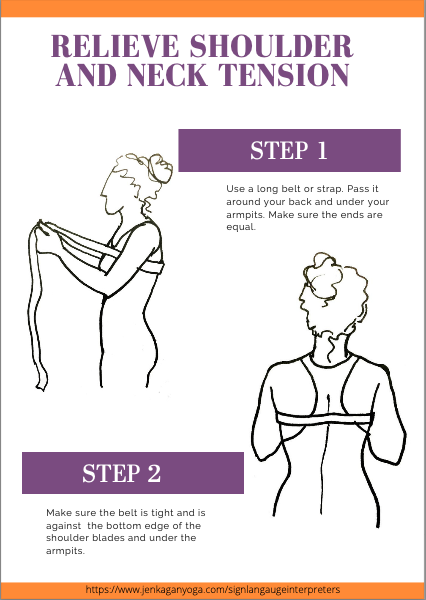
For additional support, download my free neck-tension guide and instructional video for sign language interpreters. It gives you a simple practice you can use before, during, or after work.
I have been a sign language interpreter for nearly 30 years and have taught yoga for more than 20. As a Level 3 Certified Iyengar Yoga Teacher and certified yoga therapist, I understand both the physical demands of interpreting and the importance of working progressively, precisely, and safely.
Your work asks a great deal of your body. Caring for that body is not separate from your professional development. It is part of creating a strong, healthy, sustainable career.
Contact me for a free consult where we will discuss where you are, where you want to be and how to get there.

Hi I'm Jen
I have nearly 30 years of interpreting experience and now integrate expertise in yoga and holistic health to empower interpreters to have a thriving career. With over 15 years teaching yoga and extensive certifications, including in Iyengar yoga and Ayurveda, I uniquely support the interpreter community. My programs address physical and mental challenges like repetitive strain, stress, and burnout, offering resilience-building techniques.
Follow me
NO MORE NECK PAIN
ABOUT
Jen Kagan Yoga is a place for whole-person wellness. From the ancient wisdom of Ayurveda and Iyengar yoga, somatic awareness and nervous system regulation. Offers are Ayurveda Coaching, Iyengar yoga online and in person in San Miguel de Allende, Retreats and speciality programs for interpreters.
QUICK LINKS
Created with ©systeme.io